

How it works

From enrolment to sealed history, in seven steps.

A unit in transit receives its document at enrolment, is bound to the object through its physical signature and builds up a history anyone can verify with standard tools, without depending on the registry.

  1. Enrolment

    Whoever enrols sends the unit profile (parcel, loaded pallet, mail bag…), the capture class (station, phone with SDK, third-party device or API) and, optionally, dimensions, weight, evidence and an SSCC or other references. Evidence can be uploaded or sent only as SHA-256 fingerprints if the client keeps it. They declare they upload no personal data outside the images.

  2. PID and owner key

    The registry generates 60 random bits, checks they do not exist and issues the PID with its two check symbols. It returns the owner key (pidk_…) only once: it gives full control over that unit and nothing else. Stations without network use blocks of PIDs reserved in advance by certified devices.

  3. Physical signature

    The unit’s “biometrics” are computed: geometry, weight, 3D shape, cardboard texture patches at fixed positions, tape path, label layout, appearance and damage map. A compact object with no personal data: never OCR text or label crops.

  4. Sealed and anchored record

    Everything goes into a record in canonical JSON (RFC 8785). Its SHA-256 fingerprint is signed by the device (optional, raises the level) and always by the registry (Ed25519), and enters an append-only ledger. Each UTC day closes into a Merkle tree (RFC 6962), a statement signed and chained to the previous day’s, and a Bitcoin anchor via OpenTimestamps.

  5. Public resolution

    The ID resolves at its URL, by QR or by API. Anyone sees whether it exists, when it was enrolled, with what class and level, its status, its lineage, the last verified sighting and the fingerprints to verify the record. Never images, dimensions, weight, private references or who enrolled it. A publicly linked SSCC resolves at /00/{SSCC}.

  6. Sightings

    A new capture of the same unit claims the ID and is compared 1:1 with the enrolment signature: match, review or no match, with a score per feature and an explanation. A “no match” is recorded too. It is an operator service.

  7. Lineage

    A unit is a state, not an object. If it is opened, consolidated, split or repacked, a new PID is born linked to its parents, which become “superseded”. The full history is followed through the graph.

Scope

What gets a PID and what does not.

PARCID is the identity of what travels: physical units in transit with no permanent issuer. A thing enters the registry when it meets four conditions at once.

  1. No permanent issuer

    No serial number of its own and no registry that already identifies it.

  2. It changes state

    It is closed, opened, consolidated or repacked along the way.

  3. It changes custody

    It passes through different hands: sender, warehouse, carrier, recipient.

  4. It lives briefly

    From hours to months: born when sealed, gone when delivered.

ProfileWhat it isScope in v0.1
parcelBox, envelope, drum or closed package travelling as one pieceCore: levels 0 to 3, station capture
pallet_loadA loaded pallet: the stacked, wrapped load, not the wooden palletLevels 0 to 2; own features in v0.2
container_loadThe load stowed inside a shipping containerLevels 0 to 2; own features in v0.2
toteTote, cage, roll container, barrel: returnable packagingLevels 0 to 2; own features in v0.2
bagMail sack, diplomatic pouch or luggageLevels 0 to 2; own features in v0.2
crateTransport crate for art, instruments or machineryLevels 0 to 2; own features in v0.2
A parcel in front, a loaded pallet behind it and, at the back, an open shipping container in shadow; only the parcel and the pallet carry a golden ring.

The container is context

A parcel travels on a pallet and the pallet in a container: the registry identifies the load at each level, not the permanent receptacle. The container already has its BIC code (ISO 6346) and its seal; they come in as links of the PID.
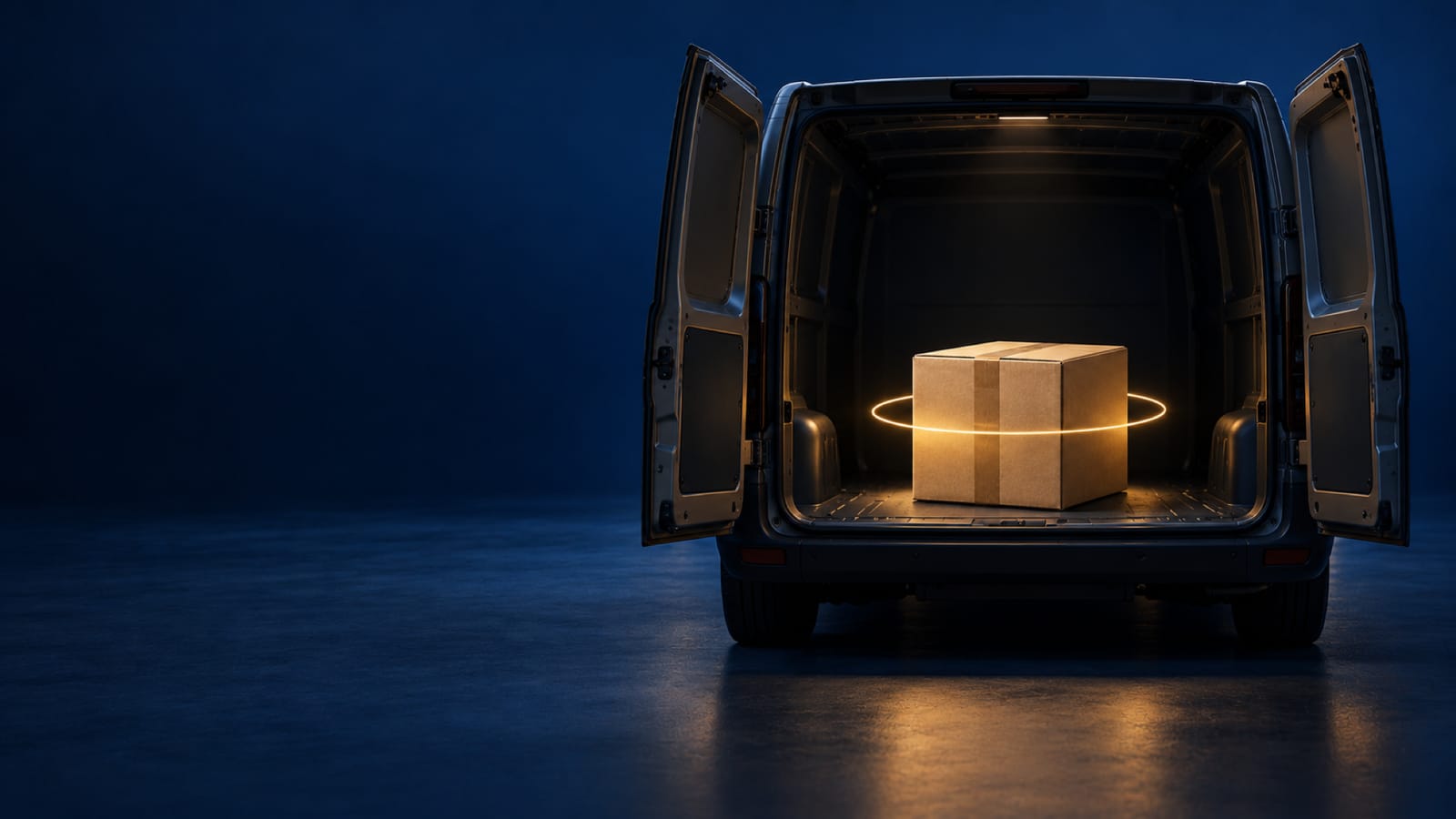

The open rear of an unmarked dark van with no plate, at night; inside, a single lit parcel with its golden ring. The van has no ring.

The vehicle is a custodian

The van or truck gets no PID: it has a VIN and a plate, and the plate identifies a person. It comes in as the unit’s custodian, with an opaque reference, never the plate in clear.

A navy hard-shell suitcase on a conveyor belt, with a blank white tag hanging from the handle and a golden ring around it.

The suitcase is the unit

A bag tag is issued for each trip; the suitcase is the same on every one. With the bag profile, the suitcase keeps its PID and the trip’s tag is linked as bag_tag.

PARCID does not identify things in general: it identifies units while they travel, and gives them context with whatever already has its own registry.

Anatomy of a record

Every record can be verified without asking us.

With the record, the registry’s public key and the inclusion proof, anyone recomputes the fingerprint, checks the signature, follows the Merkle path up to the day’s root and checks that the daily statement is signed, chained and anchored in Bitcoin.

An ivory sheet of paper with a red wax seal next to the corner of a parcel.
Diagram of the enrolment recordEnrolment recordcanonical JSON · RFC 8785pid · type · datescapture class · leveldimensions · weightphysical signature hashevidence hashesconsentrecord_hashSHA-256Device signatureEd25519 · optional · raises the levelRegistry signatureEd25519 · always · key in /.well-knownDaily statementMerkle root RFC 6962 · signed · chainedBitcoin anchorOpenTimestamps · no tokens · publicDiagram of the enrolment recordEnrolment recordcanonical JSON · RFC 8785pid · type · datescapture class · leveldimensions · weightphysical signature hashevidence hashesconsentrecord_hashSHA-256Device signatureEd25519 · optionalraises the levelRegistry signatureEd25519 · alwayskey in /.well-knownDaily statementMerkle root RFC 6962 · signedchainedBitcoin anchorOpenTimestamps · no tokenspublic
  1. Recompute record_hash over the canonical JSON
  2. Check the Ed25519 signature with the published key
  3. Follow the inclusion proof up to the day’s Merkle root
  4. Check the daily statement and its OpenTimestamps proof in Bitcoin

Do it now in your browser

Assurance levels

Calibrated confidence, not absolute uniqueness.

No physical feature is unique the way a fingerprint is. Every enrolment states how it was captured and at what level. A unit enrolled at level 1 that passes through a station obtains a level-3 sighting, and its resolution shows the best level reached.

  1. Registered (unverified) unverified

    API enrolment with no device signature and no verified evidence.

  2. Signed signed

    Ed25519 signature with the client key, valid sequence, at least 2 evidence items with hash, dimensions or weight.

  3. Attested attested

    The above + device attestation or certified device + freshness nonce + physical signature with texture patches.

  4. Station station

    The above on a registered station with normalised geometry, calibrated scale, point cloud and multi-sensor coherence + RFC 3161 timestamp.

What must be uploaded to create an ID

LevelWhat is uploadedWhat it tells apart
Minimum (L0)Nothing mandatory except the capture class. Optional: dimensions and weight.Only the document: useful to link references (an SSCC, a tracking number), not to recognise the unit.
Basic (L1)Dimensions and weight with tolerances, 2 photos (top and perspective) or their hashes, client Ed25519 signature.Separates the parcel from most of those travelling the same day on the same route.
Recommended (L2)The above + texture patches at 4 fixed positions, tape path, label layout (without its content), device attestation, freshness nonce.Separates two factory-identical boxes freshly sealed.
Station (L3)The above in normalised geometry (origin 0·0·0, rulers, fixed cameras, own lighting) + point cloud + calibrated scale + multi-sensor coherence.Comparable across machines and over time: the parcel’s “passport photo booth”.

Lineage

Opening, consolidating or repacking does not break the history.

A box that is closed, opened, unpacked or repacked is not the same unit: they are different states, each with its own PID, linked by records signed by whoever performs the operation. The child is born with its own key.

OperationParents → childrenParents’ status
open1 → 1 (the same box, opened and closed again)superseded
repack1 → 1 (another box)superseded
consolidateN → 1all superseded
split1 → Nsuperseded
attach1 → 1 (the same object gains a higher-level capture)stays active: it is a sighting, not lineage
The same box in four states from left to right (closed, opened, contents wrapped, repacked in a larger box), each with its own golden ring and joined by a thread of light.

What is not identity

They are linked to the PID. They do not replace it.

Tracking number

Set by the carrier, reused and copied.

SSCC

Identifies the logistic unit of a shipment, not the physical unit or its state. It comes in as a first-class key and resolves at /00/{SSCC}.

Label content

It is personal data and gets reprinted. It never enters the registry.